UrbageSurvey
网络信息平台支持的历史地段数据收集与城市设计
在历史地段的更新保护中,实地调研以收集数据是不可或缺的工作。由于缺乏系统的工作方法和专门的工具平台,调研工作时常效率低下,难以改良。群智计算的广泛应用启示我们,可以通过分划数据收集工作、搭建网络信息平台予以优化。本研究基于实际调研经验,搭建网络信息平台,探讨了一种多端合作、实时共享、高效便捷的调研方法,提升了调研工作效率,对于推进众包合作的历史地段更新设计模式具有重要意义。
In historic site conservation and renewal, field research for data collection is vital. Lacking systematic methods and tools, it’s often inefficient and hard to improve. The rise of swarm intelligence computing suggests optimizing via task division and a network platform. Drawing on field experience, this study builds a network platform, explores a multi-device collaborative, real-time, efficient method, boosts research efficiency, and advances the crowdsourcing model for historic site renewal.

信息收集平台总体架构
研究主要解决中国城镇历史街区人工采集数据的问题——这一环节通常是更新设计中不可避免的初步步骤,且需要严谨的团队协作。随着数字技术的发展,可构建工作群体内实时数据交互的工作流程,并开发相应的在线信息平台。然而当下,历史街区实地调研仍高度依赖分散的工作人员,包含涉及各类数据采集与评分的繁琐流程,这常导致混乱,例如评分标准不一、建筑标签冲突及调研重点误判。基于中国历史街区的特征及克罗普夫(Kropf)与马歇尔(Marshall)提出的城市形态理论,本研究建立了相关数据架构。通过在中国某历史街区的实践经验,组织构建了紧密协作的工作流程,并开发若干网页编程演示案例以验证方案可行性。经大量尝试后,确立了一套相对稳定高效的工作顺序:
- 数据预处理与上传;
- 路径规划与建筑关联(将建筑附着于路径);
- 拍照与基础信息记录;
- 建筑评分;
- 住户调查。
This study addresses manual data collection challenges in Chinese historic areas—an essential but inefficient preliminary step in renewal design requiring team collaboration. Despite digital tech enabling real-time group data interaction and online platforms, current fieldwork remains fragmented, with cumbersome data/score collection causing chaos (e.g., inconsistent scoring, label conflicts, misjudged focus). Guided by Chinese historic area traits and Kropf/Marshall’s urban morphology theory, a data structure was built. Practical experience in a Chinese historic area informed a collaborative workflow, tested via web demos for feasibility. Extensive trials yielded a stable, efficient sequence:
- data prep/upload;
- pathfinding & building-path linking;
- photo/basic info recording;
- building scoring;
- household survey.

江苏省某城镇更新项目场地概况
在该技术框架的支持下,我们已完成对江苏省某小镇的历史遗址调查与区域更新设计。该项目聚焦一座小山上的复杂区域——因该区域被城市空间环绕,自身又呈现高密度村落特征,可视为城中村。该城中村的保护与再生需开展详尽场地调查、整体规划、后续建筑设计,并兼顾遗产保护考量。为充分挖掘土地价值、提升居民生活质量,项目嵌入若干新功能,优化了路网与开放空间环境;同时提出多套建筑设计方案,涵盖部分旧建筑的保留与改造。设计有望激活该地区的不行交通和门店商业,同时让更多的市民欣赏到奇特的地形和山顶的风景。
With the support of this technical framework, we have completed a historical site survey and area renewal design for a town in Jiangsu Province. It is a renewal design of a complex area on a small hill, which may be regarded as an urban village because the area is surrounded by urban space while itself is more like a high-density village. The conservation and regeneration of this urban village requires exhaustive site investigation, overall planning, further architectural design and consideration of heritage preservation. In order to fully develop land value and improve the life quality of vulnerable residents, several new functions were embed and the environment of road network and open spaces were bettered. Also, several schemes for architectural design were proposed, including preservation and renovation of some old buildings. The design might also activate the area and the eccentric terrain as well as the scenery on the top of the hill could be enjoyed by more citizens.
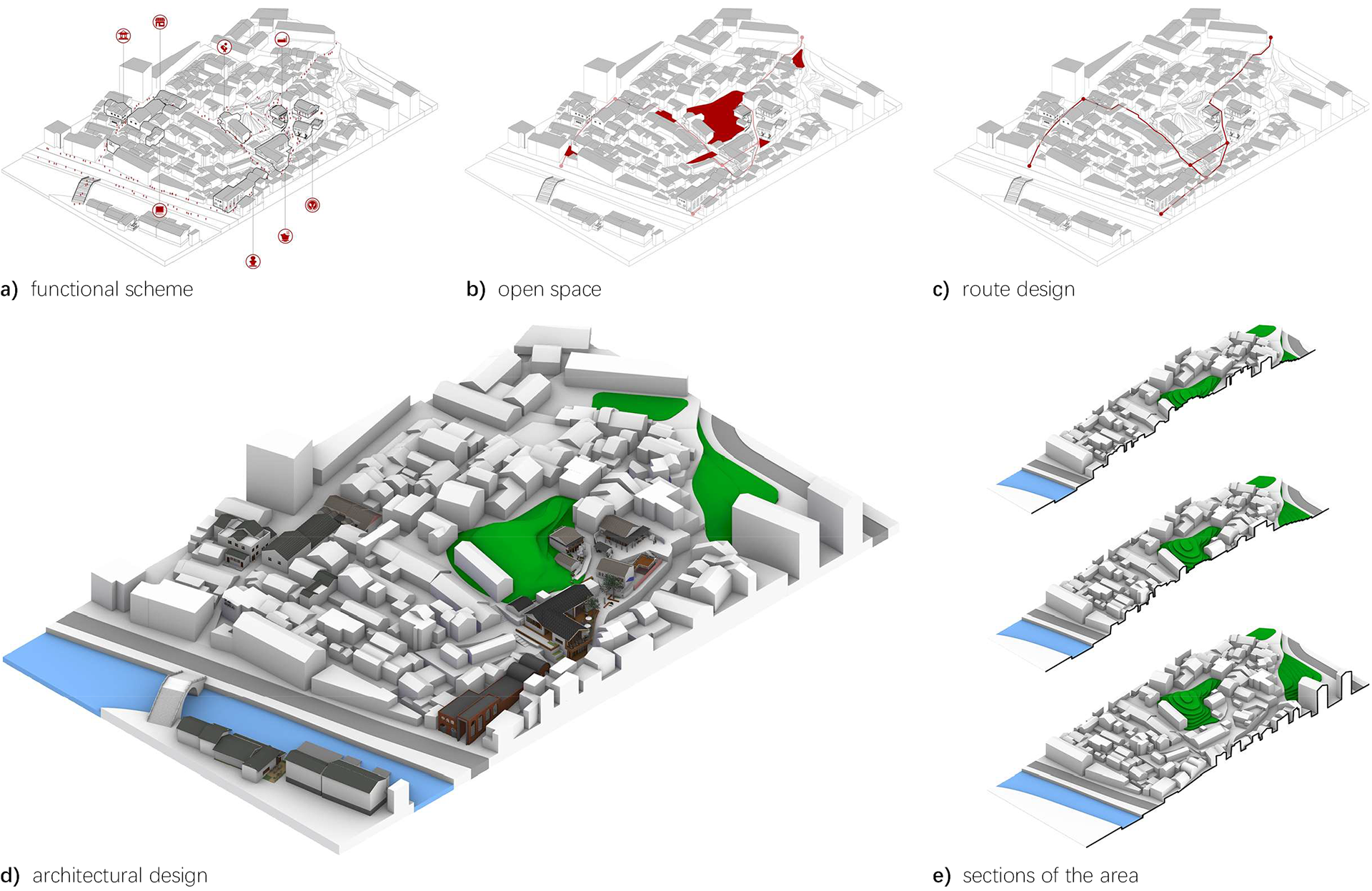
更新设计方案概况